
New
Holy Fools
A sermon on the foolishness of God that confounds the wisdom of the world, and the radical call to love our enemies.
03 min reading in—Tech
AI-assisted coding shifted from tool to colleague. Now that the typing is done, engineers can finally start thinking again.
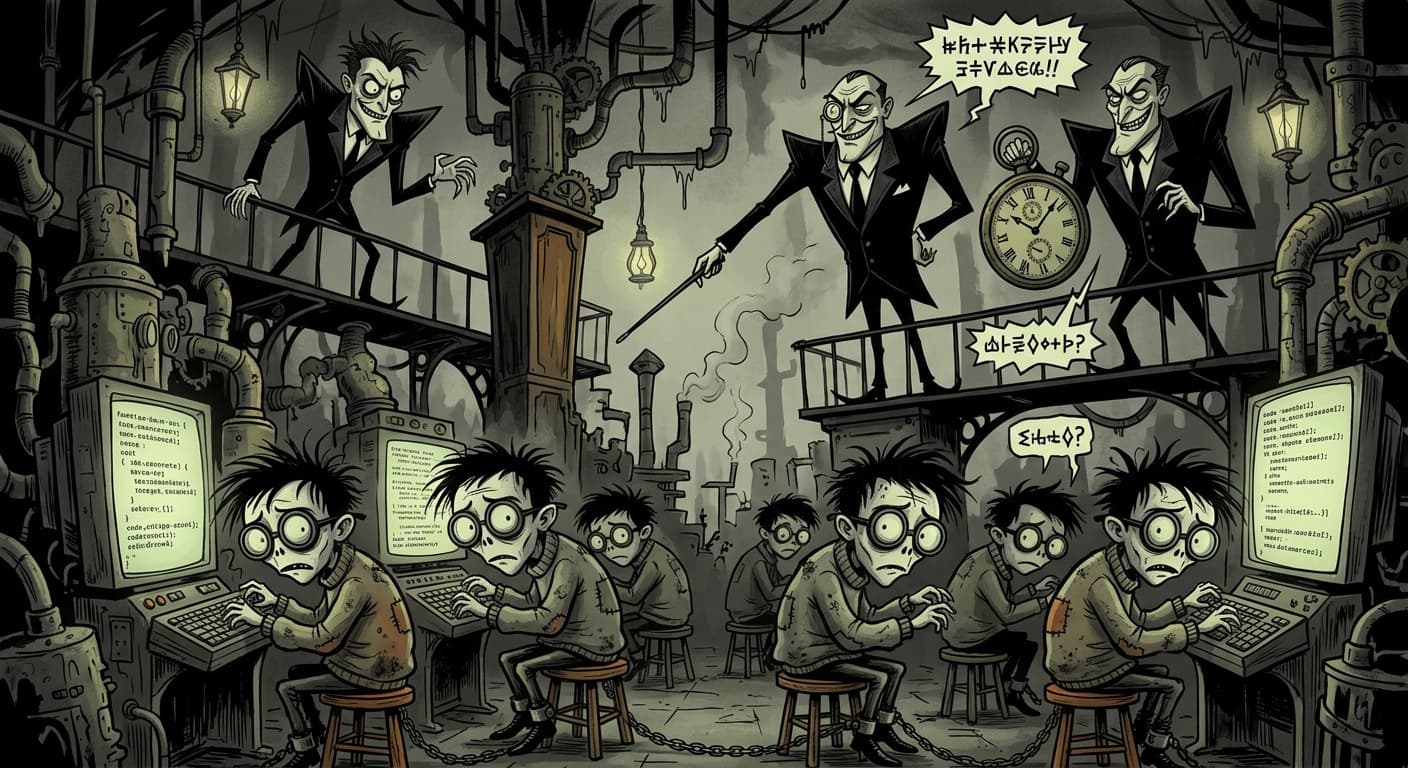
Sleep deprivation caused by frequent Iranian strikes activated my default mode network, and I decided to support my job search with some ideas that might sound superficial — but need to be voiced to become real. So let's start with this one:
Software is mostly solved.
I'm echoing many voices in the industry here: something shifted around December 2025, and AI-assisted coding stopped feeling like a tool and started feeling like a talented colleague sitting next to you, doing stuff with you, not for you.
It all sounds trivial at this point, but it's hard to discern the voices of those for whom AI has enabled coding from those of us who have been coding for a living for many years. Both perspectives are valuable — but the miracles are different. If you just discovered you can build something with AI, that's wonderful. My miracle is different: I've been a professional if-else-typist for twenty years, and I don't need to get my hands dirty anymore.
I can talk with AI about architectural decisions, about the contract points between abstraction layers, about why we made certain choices in the past — but I don't write code myself anymore.
This sounds liberating for some of us and horrifying for others: there's no need not only to write, but also to see the code with your own eyes most of the time.
So, what are we to do now, if we're not doing what we were hired to do?
It appears we can start thinking again.
I'm not really fond of "writing code" — but I am quite fond of being an engineer: planning, projecting, and building a mechanism that comes to life like a Golem: lifeless matter being animated. (No Talmudic puns intended.)
This is my passion and my joy, the reason I've been staring at this screen since the age of twelve. And I think, as time went by, I was robbed of it.
SaaS and smartphones brought money into our corner — where nerds were enjoying themselves and having much fun in their caves! — and with money came the managers, new paradigms of efficiency, whole new professions that existed just to make us predictable. Shiny glass towers were erected specifically to lure us out into the light.
Not all of it was bad. Many of us learned to build for people, not just for ourselves. (Think about your banking app fifteen years ago: horrible then, so good now.) We learned to speak the language of users and the language of business.
But with the good came the ugly: business perceived software as a bottleneck. Each line of code had a price tag. We were surrounded by managers who handled our efficiency and gradually removed the fun from the work — at least, for me.
Now, don't misunderstand me — I am not proclaiming a "back to the caves" revolution. Not just yet. But as I remember myself a few years ago, it was a sad picture.
Now, with a significant portion of my brain free from micro-decision-making, typing, and testing small and medium features, I am naturally getting back to product building: instead of thinking small and focused, I am thinking broad and big!
This sounds like the opposite of what is expected of a cubicle (or open space) dweller: mind your own and deliver your part on time. Collaborate, but not too much. Smile, but do not laugh.
I remember how it was two-three years ago and before: yes, I can think product, I got much of my career being more 'product' than not, but when you have code in front of you, you develop tunnel vision, you deliberately ignore the 'big picture' to get your job done for this day. I remember clearly that I was implementing less-than-optimal product decisions without looking back.
And over the years, when I was deprived of product thinking by product managers and other nice people, I haven't been convinced that you can painfully decouple product as a concept and idea from product as a set of features, and from product as code.
Now, I don't have to pretend that you can.
What if my part is done in an hour and tested and integrated in another hour? What if I have time to look around? What if I know something about the product we're building that no one else knows — because I'm the one building it? What if I see something that a person who never works with code simply cannot see?
I think the answers to these questions are worth exploring.
New
A sermon on the foolishness of God that confounds the wisdom of the world, and the radical call to love our enemies.
New
A sermon on the bondage of the will, the one choice that matters, and the God who makes our choosing possible.
New
A sermon on the persistent widow, the layers we build against helplessness, and what faith looks like when there is no backup plan.